Hola from Mexico. 🇲🇽
Currently on a flight to Playa del Carmen for our annual AppSumo retreat.
Aquí tienes 3 ideas en 3 minutos.
🏃♂️ “Activating” Ambition
When I was 29 I decided to run a marathon.
Later, I discovered these crazy stats showing that people in their ninth year (29, 39, 49, etc.) are disproportionately more likely to set and achieve ambitious goals.
“Nine-enders are overrepresented among first-time marathoners by a whopping 48%. The age at which people were most likely to run their first marathon was 29. Twenty-nine-year-olds were about twice as likely to run a marathon as 28-year-olds or 30-year-olds.”
— Daniel Pink author of When: The Scientific Secrets of Perfect Timing
So what’s going on here?
At first I felt like just another statistic. Then I saw what was really going on...
Humans crave meaning.
This is why our ambition is activated toward the end of a decade (nine-ender ages), the end of a year (New Year’s resolutions), and/or the end of a quarter (quarterly KPIs).
“Nine-enders are particularly preoccupied with aging and meaningfulness, which is linked to a rise in behaviors that suggest a search for or crisis of meaning.”
— Researchers Alter and Hershfield
For some, ambition is activated by dopamine hits at a young age telling us we’re good at something (ex: making a sports team, getting positive feedback from a role model, creating a viral video, etc.)
Biologically we’re wired to seek growth and improvement, so we all have it somewhere.
But it’s easier to “activate” it at a younger age when the options are more tangible. We can play multiple sports, apply to a prestigious school, go back to school for an MBA, etc.
However, as adults where do we put this?
We want to activate and channel this energy somewhere, but the options later in life are less obvious.
So many (specifically those ages ending in 9) commit to something challenging like a marathon.
This feels good because it’s tangible and specific.
But the reality is it doesn’t really matter what we do, as long as we do something.
“General ambition gives you anxiety. Specific ambition gives you direction.”
— George Mack
So it’s less about activating our own “ambition” or even if we resonate with that term.
It’s really about activating our own EVIDENCE.
Evidence of specific things we’ve done and therefore know we can do.
Not sure where to start? Find people who have accumulated their own evidence. 👇
📈 Compounders
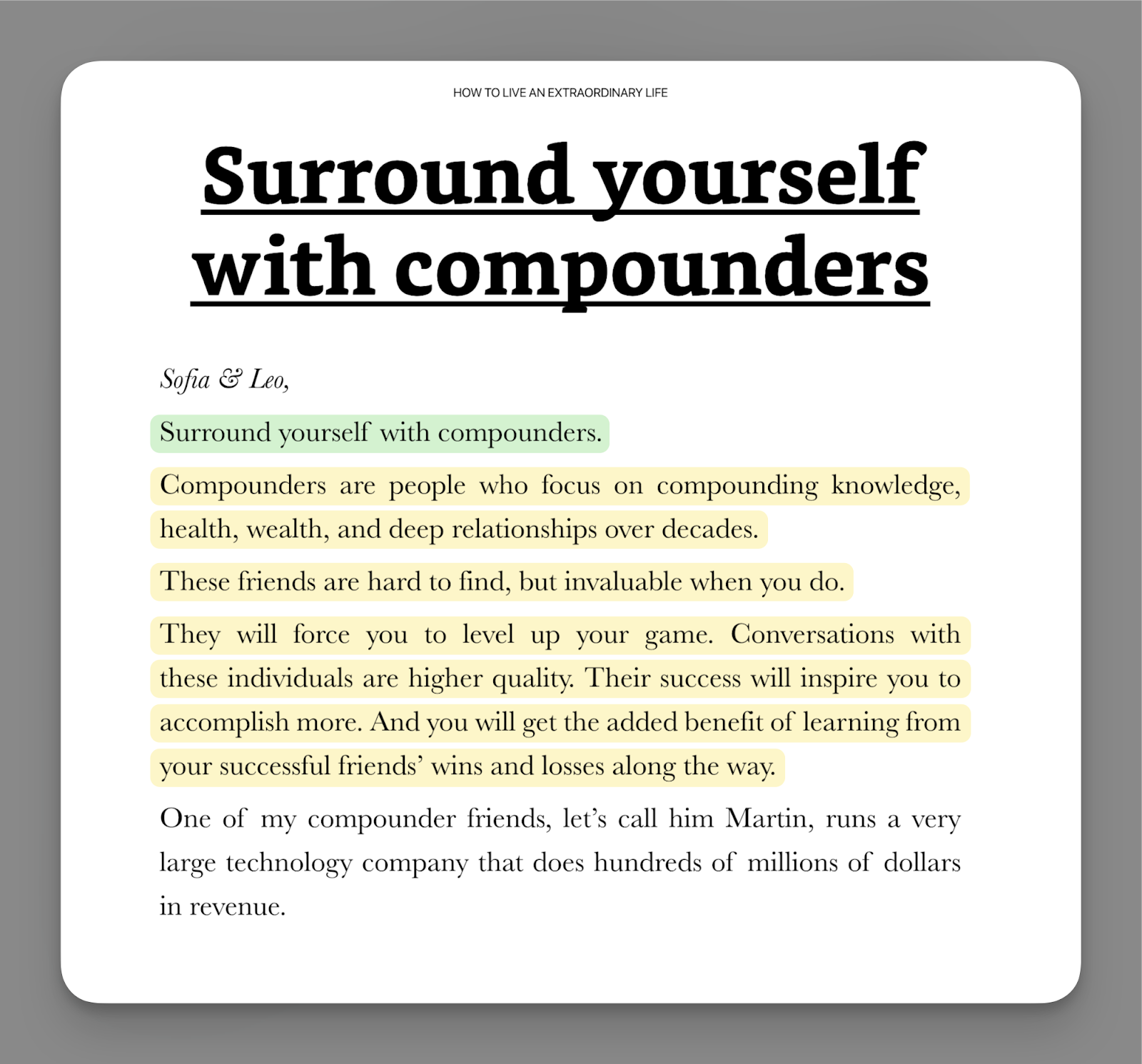
Anthony Pompliano wrote 65 short letters to his kids on how to succeed in business, relationships, and life.
He then turned into a book called, How to Live an Extraordinary Life.
It’s a cool concept to create something like this for your kids. (Which also happens to be packed with insights for any age.)
I loved this idea to surround yourself with compounders.
🔍 EXTRAordinary
Everyone wants an extraordinary 10/10 outcome—success, money, fulfillment, etc.
But few put in more than a 5/10 input (above average) toward getting it.
The funny part is… we fool ourselves into thinking we’re unique.
The “better-than-average” effect is a cognitive bias where people perceive themselves and their abilities as above average.
80% of men think they're above average drivers (AAA study)
65% of Americans believe they’re above average intelligence (survey)
94% of professors rated themselves above average to their peers (study)
By definition, of course, everyone can’t be above average. So what gives?
Here’s the thing.
Everyone wants extraordinary results.
Most believe they are extraordinary themselves.
But only a few put in the extra ordinary daily effort over a long enough horizon to achieve above average outcomes.
Extraordinary always starts with extra ordinary.
The basic, ordinary things that compound over time.
What looks effortless today, required much effort in the past.
Feel stuck? Shrink down the effort and expand the time period.
The trick is to get momentum (aka evidence) and we start to feel ahead.
Keep going.
Salud,
Mitchell
0 comments